
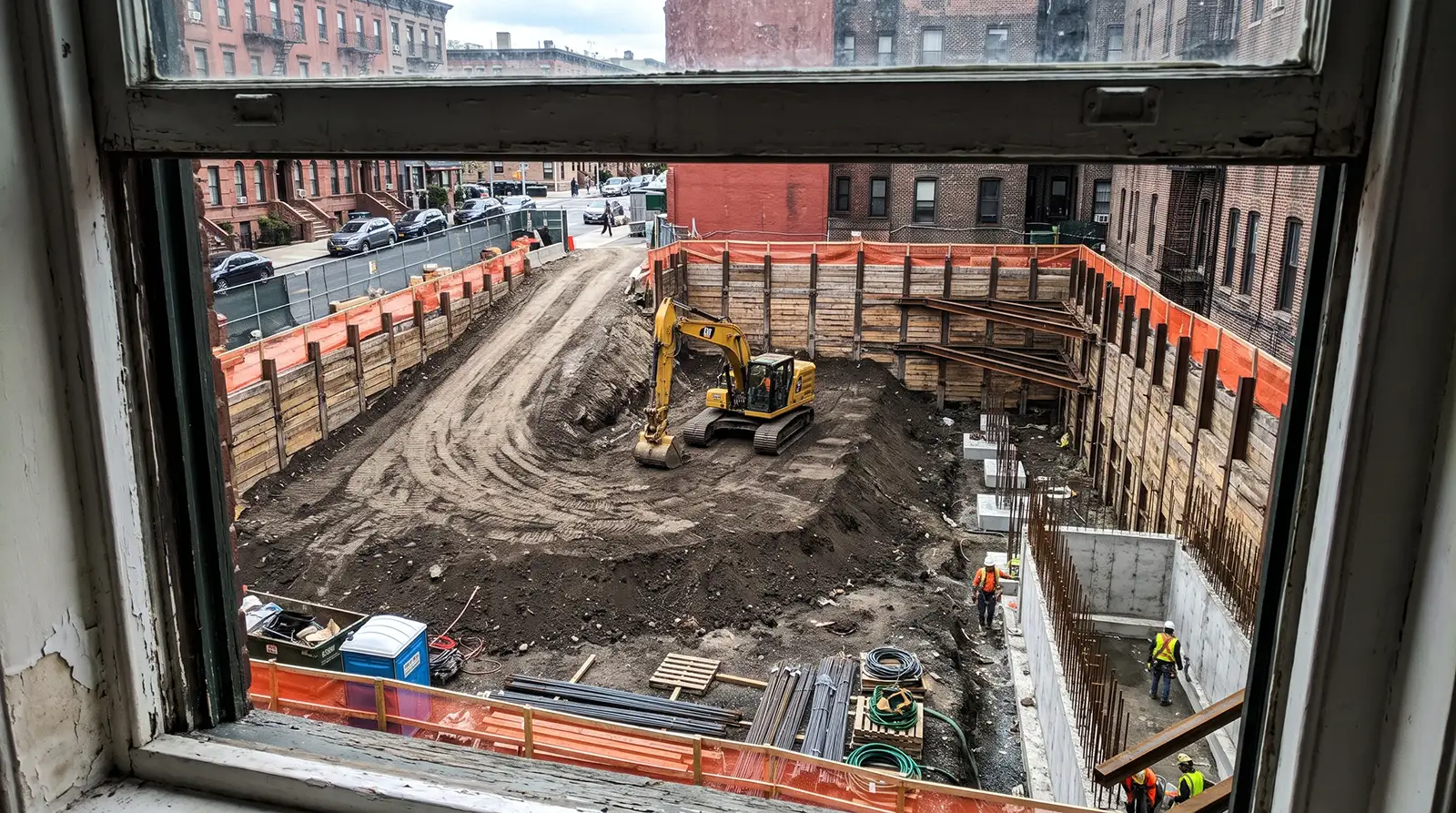
One week, the property next door may be an empty lot, a quiet building, or a barely noticeable renovation site. Then excavation begins, trucks arrive, equipment starts running, and vibrations become part of the day. When construction next door becomes part of daily life, residents of the adjoining building face an understandable question. What is normal construction activity, and what deserves closer attention?
The tragic events in Flatbush, Brooklyn, where a three-story building collapsed beside an active work site, have drawn renewed attention to building safety across New York City. If excavation, demolition, or foundation work raises a legitimate safety concern, what warning signs deserve attention? How should you document them, and where can you report your concerns?
The cause of the collapse remains under investigation, so no premature conclusions should be drawn about neighboring construction or the companies involved. What the incident does underscore, however, is the importance of public awareness. Residents should know how to verify construction permits, recognize meaningful changes in an existing building, and respond appropriately when concerns arise.
Construction next door does not automatically mean that an adjoining building is unsafe. Excavation, demolition, renovation, and new construction routinely take place beside occupied buildings across New York City. Residents do not need to become structural engineers. They do need to know where to find reliable information, what changes are worth documenting, and when professional or municipal intervention may be necessary.
Immediate danger? Leave first.
If the building appears to be collapsing, structural debris is falling, or sudden movement suggests immediate instability, leave the unsafe area and call 911. Do not stop to take photos, check permits, or investigate the condition yourself.
For shaking, persistent vibration, leaning, cracked or bulging walls, or other building-safety concerns that do not present an immediate danger, report the condition through NYC311.
What Should You Check During Construction Next Door?
When construction next door begins, start with facts rather than assumptions. Verify what work has been filed or permitted. Record the current condition of your apartment and common areas. Pay attention to changes instead of treating every sound or vibration as evidence of a problem. If something appears unsafe, New York City provides formal channels for reporting it.
- Check the project through NYC Department of Buildings records.
- Identify whether excavation, foundation work, demolition, support of excavation, or underpinning is involved.
- Document the current condition of your apartment and relevant common areas.
- Watch for new or changing physical conditions rather than isolated imperfections that may have existed for years.
- Use NYC311 to report legitimate non-emergency construction or building-safety concerns.
- Call 911 and leave the unsafe area when there is an immediate threat to life or structural safety.
These steps do not replace a professional inspection. Their purpose is to separate information residents can verify from conditions requiring DOB, building management, or a licensed professional.
Start With What Is Actually Permitted
Construction next door can look alarming from an apartment window. Deep excavation, temporary bracing, and heavy equipment can amplify that impression. This is especially true when the purpose of the work is unclear. Before drawing conclusions from street-level activity, check what has been filed with the New York City Department of Buildings. Public records can reveal the work type, active permits, applications, complaints, violations, and other property information.
That first check is important because construction activity has several distinct technical categories. Excavation may form part of earthwork, foundation work, or another approved scope. Protective systems may require separate filings. A permit should not replace observation of actual conditions. It confirms authorized work but does not establish that every visible condition is safe.
How to Check DOB NOW and Building Records
The safest approach is to check both the DOB NOW Public Portal and the Buildings Information System, or BIS. DOB explains that the two systems contain different generations and categories of records, so relying on only one can leave part of a property’s history unseen. Older permits, applications, complaints, violations, and inspections may remain in BIS, while newer DOB NOW filings appear through the Public Portal.
Start with the address of the construction site rather than your own building. Review the applications and permits to understand the approved work types, then check complaints and violations associated with the property. DOB notes that complaints generated through 311 remain in BIS. Some violations are also found only there. BIS therefore remains relevant even for projects filed through DOB NOW.
The city’s Get Building History guidance is a useful starting point if the records are unfamiliar. Look at whether permits are active, what work they cover, whether complaints have been filed, and whether violations or enforcement actions appear in the property history. An old complaint or resolved violation is not proof that current work is unsafe, just as the absence of a complaint is not a professional safety assessment; the records provide context that must be interpreted carefully.
Terms Worth Recognizing
Earthwork covers excavation as well as certain grading, fill, sitework, and soil-improvement operations in the DOB NOW system. If you see an Earthwork, or EA, filing, it tells you that the project involves work with the ground itself. DOB also requires contractors with permits to conduct earthwork to notify the Department before excavation begins.
Support of Excavation, usually shown as SE, refers to systems that temporarily retain or stabilize soil while excavation is underway. Depending on the project, this can include shoring, bracing, benching, piles, tiebacks, anchors, slurry walls, or other engineered systems. The DOB NOW Build FAQs specifically distinguish this temporary support from underpinning.
Underpinning addresses the support of an existing building or foundation when additional or altered foundation support is required. DOB files underpinning under Foundation work rather than Support of Excavation. It creates a new permanent foundation condition beneath the supported structure. That distinction matters when reviewing public records. An SE filing alone may not reveal whether the project includes underpinning.
Foundation work can include shallow or deep foundations, retaining walls, tiebacks and anchors, underpinning, and related work. Demolition involves removal of all or part of an existing structure and carries its own permitting and safety requirements. Residents do not need to master every filing category. They should recognize when construction next door involves soil, foundations, structural support, or demolition.
Why Excavation Next Door Deserves Attention
Construction next door deserves closer attention when excavation changes the physical conditions around an existing building. Removing soil can alter how nearby ground is retained and how existing foundations require support. NYC Building Code addresses these conditions through adjoining-property protections. Those rules reflect New York’s dense building conditions. Properties may share party walls or stand only inches from an excavation.
That does not mean an older or pre-war building beside an excavation is automatically in danger. Age alone does not determine structural risk; existing condition, foundation configuration, soil conditions, excavation depth, distance, design, sequencing, and protective systems all matter. Excavation near an existing structure is an engineered condition. It is not simply the removal of soil from an adjacent lot.
Under NYC Building Code Section 3309.4, soil or foundation work must preserve and protect adjoining structures from damage. Where the bottom of a new excavation reaches or extends below the level of an adjoining foundation, the code requires the adjoining structure’s vertical and lateral loads to be supported through appropriate foundations, underpinning, or another equivalent method.
What “Protection of Adjoining Property” Actually Means
“Protection of adjoining property” is not a general expression of good practice. It is a specific part of NYC Building Code. It governs how construction and demolition operations must protect neighboring property. The requirements address structural elements and conditions that can be affected when work occurs immediately beside another building.
Section 3309 requires protection for elements including footings, foundations, party walls, chimneys, skylights, and roofs. Additional provisions address excavation, underpinning, water runoff, examinations, monitoring, and access to adjoining property. Protective measures depend on the work and existing conditions. One visible system, such as bracing, rarely tells the whole story.
Party walls deserve particular attention in dense New York neighborhoods. Where excavation affects a party wall, the code requires that wall to be preserved in a safe condition. Residents do not need to evaluate that engineering themselves. Knowing the requirement exists makes it easier to ask informed questions.
Know the Difference Between Normal Construction and a Changing Building
Construction is disruptive by nature. Trucks create vibration, demolition makes noise, excavation moves soil, and power tools transmit sound through masonry, concrete, framing, and shared walls. Dust, intermittent vibration, and loud periods of work can therefore occur without indicating that an adjoining building has suffered structural damage.
The more useful question is whether something in your building has changed. A crack that has been present and stable for ten years means something different from a new crack that appeared after excavation began and continues to widen. Likewise, an old door that has always rubbed against its frame is different from several doors suddenly becoming difficult to close over the course of active foundation work.
Context, timing, progression, and location matter. Residents should pay particular attention when several changes appear together, when a condition develops rapidly, or when movement seems to continue rather than stabilize. None of those observations establishes a cause by itself, but they provide information that a building manager, DOB inspector, engineer, or architect can evaluate more effectively.
Warning Signs Worth Documenting
Conditions worth documenting include:
- new cracks in walls, ceilings, masonry, or finishes;
- existing cracks that noticeably widen, lengthen, or change;
- doors or windows that suddenly begin sticking or no longer align as they did before;
- new separation between walls, ceilings, floors, trim, or other building elements;
- noticeable changes in floor level or previously stable surfaces;
- unusual movement, shaking, or persistent vibration;
- new water intrusion or moisture appearing during excavation or construction;
- visible changes around party walls or other adjoining surfaces.
A crack alone does not establish that construction has damaged a building. During construction next door, the timing and progression of a crack matter more than its mere presence. Cracks can result from settlement, temperature and humidity changes, material movement, previous repairs, ordinary aging, or many other conditions unrelated to the work next door. The important information is whether the condition is new, whether it is changing, where it appears, when it appeared, and what else was happening at the time.
NYC311 specifically accepts reports concerning buildings that are shaking, vibrating, leaning, or showing cracked or bulging walls that may affect stability. That does not mean every cosmetic crack should trigger an emergency response. It means residents should distinguish between ordinary imperfections and meaningful changes rather than dismissing a new condition or diagnosing it themselves.
Document Your Building Before You Need the Documentation
The best time to photograph the condition of your apartment is before you need to prove that something changed. Before significant construction next door begins, create a simple visual record of your apartment. Photograph walls, ceilings, floors, windows, door openings, corners, and any existing cracks. Photographs taken after a concern develops are useful, but photographs showing the condition before work began provide a far stronger point of comparison.
Documentation does not need to become a technical survey. Record the date, room, approximate location, and enough surrounding context to show where the photographed condition sits within the space. For an existing crack or irregularity, take both a wider photograph and a closer image so that later comparisons do not depend on memory alone.
If a condition changes, repeat the photographs from approximately the same position and keep the earlier images rather than replacing them. Write down when the change was first noticed and whether it appears stable or continues to develop. This record does not prove causation, but it gives professionals and agencies much better information than a general statement that “the wall looks different.”
Why Preconstruction Surveys Matter
For certain excavation conditions, documentation is not merely a sensible precaution for residents. NYC Building Code Section 3309.4.3 requires a preconstruction survey before excavation between 5 and 10 feet deep when it occurs within 10 feet of an adjacent building, and before excavation deeper than 10 feet anywhere on the site. The survey documents the existing conditions of adjacent buildings before the qualifying excavation begins.
Monitoring requirements can also apply during excavation. Under Section 3309.4.4, buildings within a specified distance of the excavation must be monitored, and historic structures receive additional protection within defined distances, subject to the exceptions set out in the code. These requirements create a professional baseline for detecting movement during work rather than relying only on impressions after something appears to have changed.
Professional monitoring exists for a reason, but residents can still maintain their own dated record of visible conditions. Personal photographs are not a substitute for the required survey or instrumentation, yet they can help a resident communicate precisely with a landlord, board, managing agent, inspector, or design professional. The two forms of documentation serve different purposes and should not be confused.
When Should You Report Concerns About Construction Next Door?
Not every vibration requires a complaint, and not every crack requires an emergency call. A responsible response depends on what is actually happening, whether the condition is changing, and whether there is an immediate risk to people. New York City separates non-emergency construction and building complaints from situations that require 911.
If construction next door appears inconsistent with approved work, document what you observe when it is safe to do so. The same applies if significant vibration persists or a new building condition develops. Do not enter the construction site, interfere with workers, or place yourself in danger to gather evidence. Use the city’s reporting systems and allow inspectors or qualified professionals to evaluate conditions that fall outside a resident’s expertise.
When to Use 311
The NYC311 Building Construction Complaint service accepts reports about active construction that appears unsafe, is being performed without a permit, is occurring outside approved plans, or presents other construction-related problems. NYC311 also provides specific complaint routes for demolition, unstable buildings, work occurring despite a Stop Work Order, and construction without adequate protection to neighboring property.
You can also report an excavation that appears to be undermining a nearby building through NYC311’s Excavation Undermining Nearby Building service. When filing a complaint, describe the condition as precisely as possible rather than trying to diagnose its cause. Include the address, what you observed, where it occurred, when it began, and whether the condition is changing.
After a complaint is filed, DOB states that you will receive a Service Request number. Keep that number and use the NYC311 Service Request Lookup to follow the status of the report; DOB-related complaints can also appear in BIS. If the condition changes materially after the initial report, document the change and contact the appropriate city service again rather than assuming the original complaint automatically reflects the new situation.
When It Is a 911 Emergency
Do not spend time searching DOB records when there is an immediate threat to life or safety. NYC311 directs residents to call 911 when a building is dangerous, is collapsing or appears likely to collapse, or when falling debris presents an immediate hazard. The same principle applies when sudden movement or another rapidly developing condition makes remaining in the area unsafe.
Examples include an active or partial collapse, falling structural material, obvious sudden movement of a building element, or severe separation developing rapidly alongside other signs of instability. Residents should not remain inside a potentially unsafe location to photograph a condition, measure a crack, or determine whether a permit exists. Leave the unsafe area and call 911.
The distinction is simple: 311 is the city’s route for non-emergency complaints and conditions requiring investigation, while 911 is for immediate danger. The NYC311 Unstable Building guidance makes that distinction explicit and should take priority over any online checklist when a real emergency is unfolding.
What Residents Should Not Try to Diagnose Themselves
Observation is useful; diagnosis is a different matter. During construction next door, a resident can document a new crack, a door that stops closing properly, or persistent vibration. They can also check DOB records and report concerns. What a resident generally cannot determine from those observations alone is why the change occurred or whether it reflects structural movement.
Statements such as “the excavation damaged my foundation” or “this is a structural crack” require evidence and professional judgment. Similar visible symptoms can arise from very different causes, and assigning responsibility before those causes have been established can be technically wrong as well as legally problematic. Describe what you can observe and leave conclusions about causation, structural significance, or responsibility to the appropriate professionals and authorities.
This guide is therefore educational, not a structural assessment of any individual property. Its purpose is to help residents recognize when more information or professional evaluation is warranted. A photograph, permit search, or 311 complaint can begin that process, but none replaces an inspection of the actual conditions.
When a PE or RA Should Become Involved
Significant, progressive, or unexplained changes may require professional assessment. The owner, board, or building management should then involve an appropriately qualified New York State licensed professional. A professional can review the building, construction documents, site conditions, monitoring data, and other evidence unavailable to residents.
Professional involvement also matters before problems arise. NYC’s Building Code requires monitoring for certain buildings affected by excavation, and historic structures can trigger additional monitoring requirements when excavation occurs within the distances defined by the code. Those requirements establish measurable conditions and track movement before visible damage becomes obvious.
Older buildings deserve informed attention, not automatic suspicion. New York contains masonry buildings, wood-framed structures, pre-war apartments, brownstones, and mixed-use buildings. Their foundations and histories can differ significantly. Understanding the actual building matters far more than making assumptions based solely on its age.
For Co-op and Condo Boards: Questions About Construction Next Door
Boards, managing agents, property managers, and owners have an opportunity that individual residents often do not: they can begin asking technical and administrative questions before neighboring work reaches its most disruptive stage. If construction next door involves excavation, demolition, or foundation work, early communication becomes especially important. It can clarify the scope, identify responsible professionals, and establish how concerns will be handled. Waiting until residents begin reporting cracks or vibration makes that process much harder.
New York’s adjoining-property provisions include requirements involving notification, physical examination, access, protection, and monitoring under specified circumstances. The exact obligations depend on the project, so a board should not assume that every neighboring job requires the same measures. It should, however, know enough to ask whether the requirements applicable to that particular project have been addressed. Homeowners planning renovations within their own co-op should also understand the building’s approval process before work begins, which we explain in What Homeowners Should Know About Co-op Board Approval for Renovations in NYC.
Useful questions include:
- What work is proposed immediately beside the property?
- Will excavation extend below the bearing level of neighboring foundations?
- Is underpinning anticipated?
- What Support of Excavation system is proposed?
- What adjoining-property protection measures apply?
- Is professional monitoring required, and what conditions will be monitored?
- Has a preconstruction survey been completed where the Building Code requires one?
- Who is the project’s Registered Design Professional?
- Who is the appropriate project contact if conditions in the adjoining building change?
- What access to the adjoining property, if any, is being requested for inspection, monitoring, or protection?
These questions do not turn a board into the project’s engineer, nor should they. They create a clear channel for obtaining information and make it easier to identify which issues belong with the neighboring owner, project professionals, the board’s own consultants, DOB, or legal counsel. In dense New York construction, clarity before work begins is considerably easier to manage than confusion after a condition develops.
Construction Next Door Does Not Automatically Mean Danger
New York City depends on construction, renovation, excavation, demolition, and the continual adaptation of existing buildings. Much of that work takes place beside occupied properties without serious incidents because building codes, engineering, inspections, protective systems, and professional oversight exist to manage risks that are inherent in working in a dense urban environment. The presence of construction next door is therefore not, by itself, evidence that an adjoining building is unsafe.
Construction next door does not automatically mean your building is at risk. But changes in an existing building during excavation, demolition, or foundation work should never be ignored. Document what you see, verify the work through official NYC resources, and report conditions that raise legitimate safety concerns.
Awareness still matters. Residents are often the people most familiar with how their own apartment or building looked and behaved before work began, which means they may be among the first to notice that something has changed. The useful response is not panic or amateur diagnosis; it is accurate documentation, verification through official records, and escalation through the right channel when conditions warrant it.
Knowing where to look, what to document, and when to speak up gives residents a practical role without asking them to make judgments that belong to engineers, architects, inspectors, or emergency services. In a city where buildings and construction sites often exist only feet apart, that kind of informed attention is part of responsible urban living.
Editor’s Note: This guide is provided for general educational purposes and is not a structural assessment of any individual property. Public records, photographs, visible conditions, or information obtained through 311 cannot replace an on-site evaluation by the appropriate licensed professional.
Scope Note: City Design Services does not perform underpinning, excavation, foundation, or structural engineering work. This article is intended to help New York residents understand publicly available building information and recognize when concerns should be referred to the appropriate authorities or qualified professionals. Structural and foundation conditions should be evaluated by appropriately licensed professionals and handled by contractors properly qualified and insured for that scope of work.